


Ford Mustang Cobra R: First Drive
The GT350 might be the ultimate track Mustang you can buy today, but it wasn't always.
The
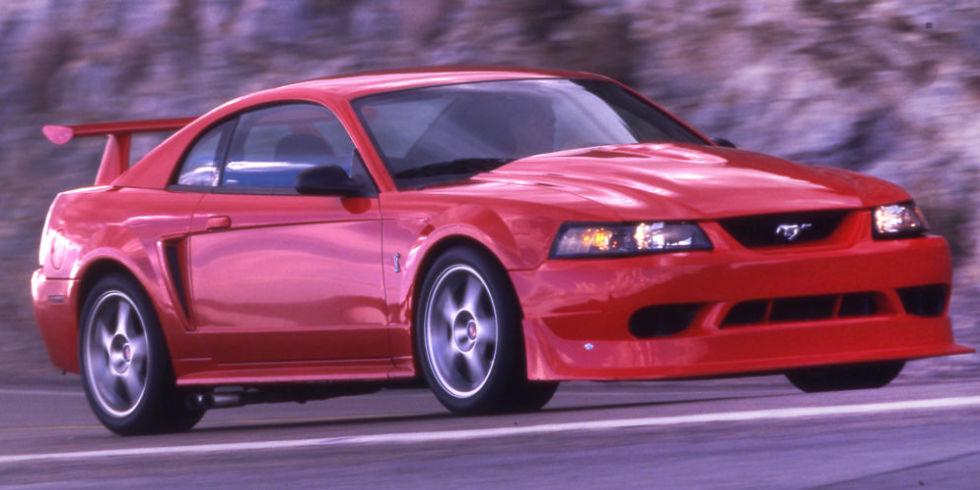
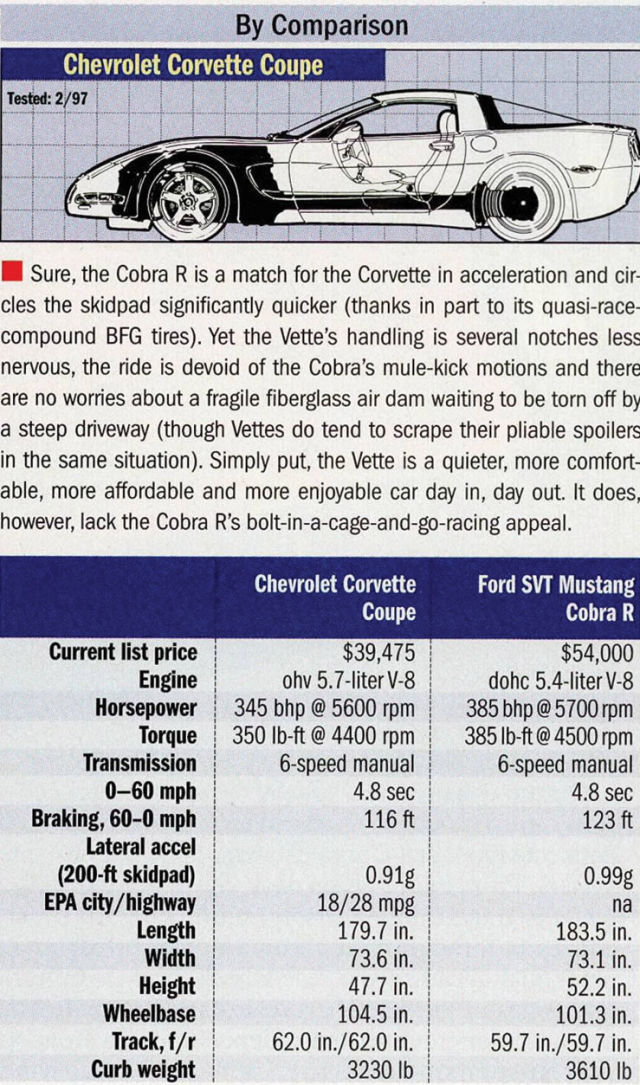
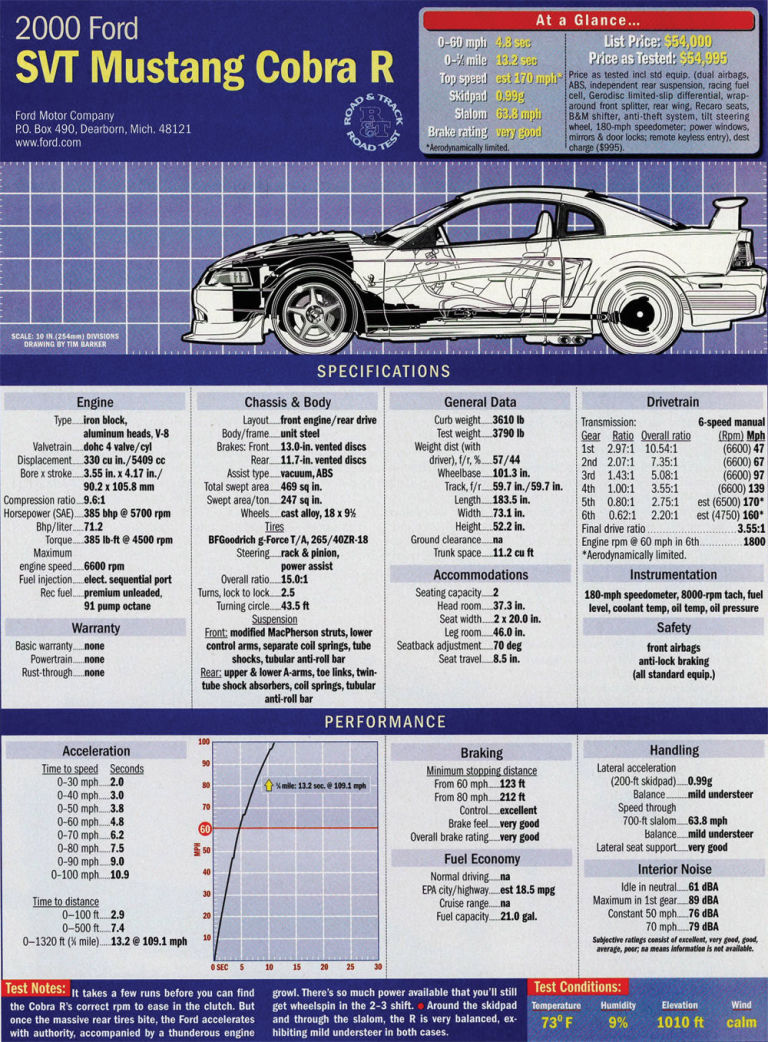
Great Pony Car War is over. Reaching 60 mph in a scant 4.8 seconds, the
limited-production Mustang Cobra R has finally outgunned Chevy's Camaro
SS. To be sure, there will be some residual skirmishing between the
standard Mustang Cobra and the SS, as well as the V6-powered variants.
But for the most part it's over. Don't expect an SS-R response from
Chevy, because such a vehicle would clearly tread on the Corvette's
turf, a scenario that has been scrupulously avoided.
That
a production Mustang is being mentioned in the same breath as the
Corvette brings a huge smile to Special Vehicle Engineering honcho John
Coletti, the godfather of the Cobra R.
At last, Ford has the goods.
Unfortunately,
Ford is planning a limited-production run of only 300, making the Cobra
R a rare commodity out on the street. That doesn't lessen the impact of
what Coletti & Co. have accomplished. The Mustang Cobra R
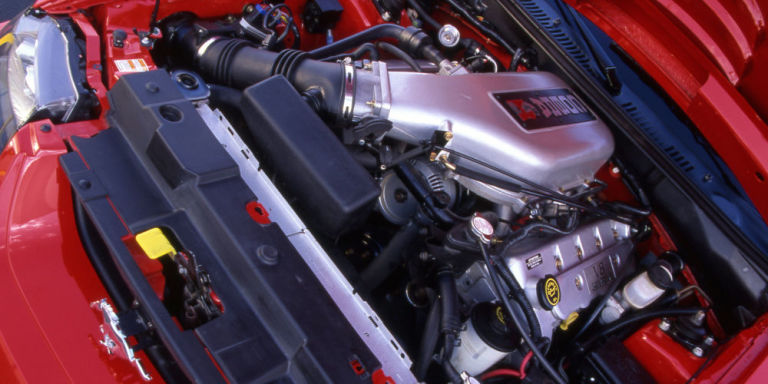
delivers 385 Ib.-ft. of torque at 4500 rpm from its normally aspirated
5.4-liter DOHC Triton V8.
This
cast-iron V8, a star in Ford's truck lineup, is derived from the
aluminum-block modular 4.6-liter V8 used in the Mustang. While bore
centers are the same, the Triton has a 29-mm-taller deck and a 105.8-mm
stroke, 15.8 mm longer, giving it the larger displacement.
The
deck height, however, was the biggest obstacle to its use in the
Mustang. Coletti practiced by first shoehorning a flex-fuel Triton into
the Mustang Super Stallion show car for the 1997 SEMA show in Las
Vegas. Also beneath the skin were two other features worth noting, an
independent rear suspension and a fuel cell, both of which are used on
the Cobra R.
Like
the Super Stallion, the Cobra R has new engine mounts and a cross
member lowered 0.5 in. as well as a huge power dome on the hood to
accommodate the taller engine.
The
Triton V8 is fitted with Carrillo billet-steel connecting rods and
forged aluminum pistons with flat tops to bump the compression ratio to
9.6:1. The engine has a new crankshaft damper, a Canton Racing Products
oilpan and windage tray. The Cobra R also benefits from more aggressive
cam profiles. The stock 10-mm lift has been increased to 13 mm on
intake and 12 mm on exhaust.
But
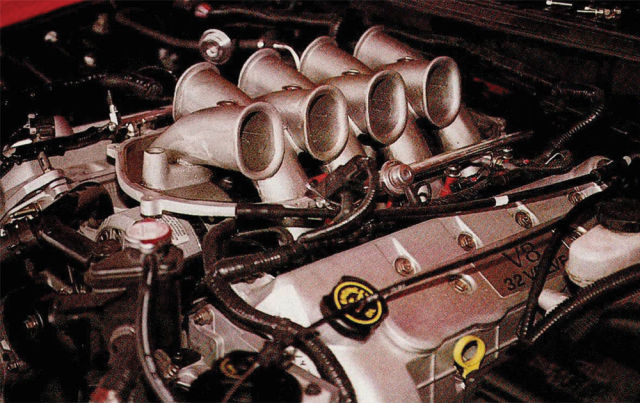
the key to the 5.4's brawniness is better breathing. The 4-valve
cylinder heads feature larger exhaust ports, which help increase airflow
by 25 percent over the Cobra's stock 4.6-liter engine. The intake
manifold sports spectacular, curved air trumpets that are hidden
beneath the plenum cover. Coletti wishes the cover could be made
transparent to show off this bit of casting artistry.
On
the exhaust side, tubular headers flow into Bassini X-pipes, which are
connected to stock Cobra catalytic converters. From the catalysts back,
the exhaust is routed through Borla mufflers and exits through twin
chrome-tipped pipes just ahead of the rear wheels on both sides of the
car. The side exhausts are necessary due to the independent rear
suspension and the 21.0-gal fuel cell that block the way aft.
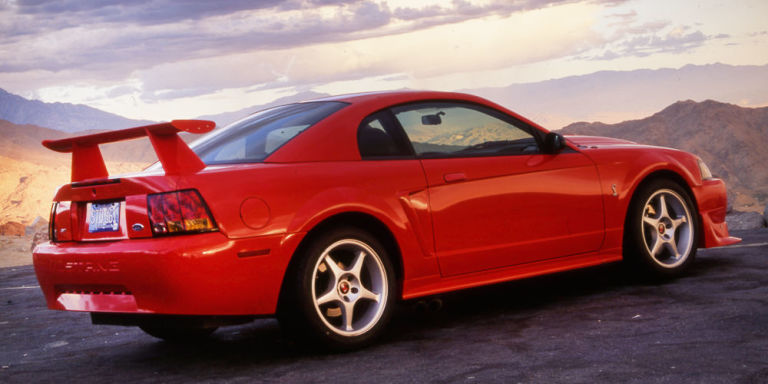
Consequently, the Cobra R is fitted with the stock rear bumper fascia
from the V6 Mustang, which has no rear cutout for exhaust tips.
Other
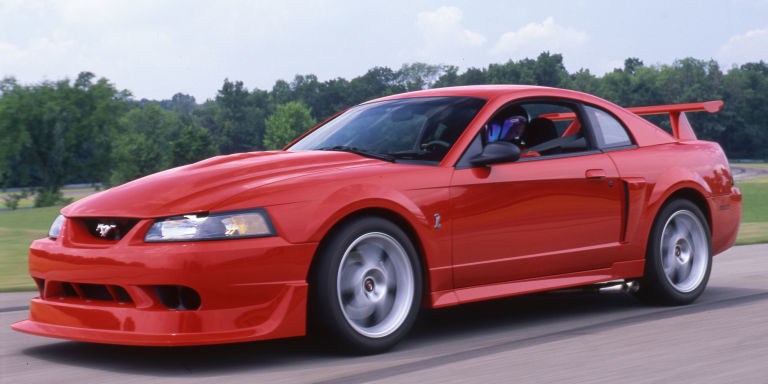
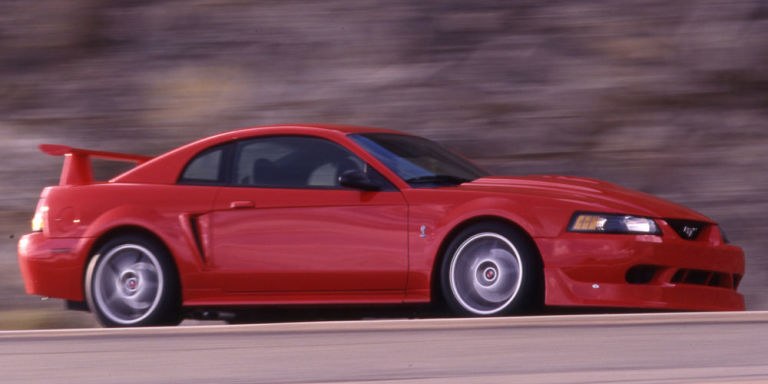
cues that set the Cobra R apart from the Mustang Cobra include a front
splitter, the high-mount fixed rear wing and rocker-panel extensions.
Though the car was initially previewed in Grabber Orange, all Cobra Rs
are painted a much more subdued shade of red.
The
engine may be the centerpiece of the street-legal Cobra R, but just as
much attention has been paid to making the car a turn-key racing
machine. That's evident from the stark interior, which has no rear seat,
air conditioning or sound system. The Recaro sport seats provide the
kind of support you'd expect from a competition bucket with just enough
padding to make it almost too comfy. The driveline is also set up to
handle the rigors of racing. The short-throw Tremec 6-speed manual
is mated to the same 11-in. clutch plate used in the Cobra, but to the
rear is a Gerodisc hydromechanical differential that improves torque
distribution especially under hard acceleration. A 3.55:1 final drive
(versus the Cobra's 3.27:1 unit) and GKN halfshafts complete the
package.
The
Cobra R's front ride height is lowered by 1.5 in. and its rear by 1.0
in. through its Eibach springs. The rates, 800 lb. per inch in the front
and 750 lb. in the rear, are considerably stiffer than the 500-lb.
front and 470-lb. rear springs found in the stock Cobra and necessitate
premium Bilstein shocks. Stiffer bushing material is also used on the
suspension attachment points.
Out
on the street, the Cobra R exhibits no rough edges. Even though much of
the sound insulation has been removed to further lighten the vehicle—
it still registers a hefty 3610 lb.—the Cobra R doesn't inflict the
same kind of body punches you'd expect from a race car. Despite the heft
of the suspension and the absolute lack of body roll, there is enough
fore-and-aft compliance to make the ride bearable. The action of the
rack-and-pinion is linear, with a nice solid feel. The unit is from the
Cobra and benefits from a new boost curve and stiffer T-bar to enhance
on-center feel.
The
throaty exhaust barks with an urgency that is directly proportional to
the accelerator angle. The Cobra R is brutally fast. Without much
effort I found myself hitting 135 mph on a long open straight. Coletti
believes the car is good for 170-175 mph and was preparing to take the
car to Ford's 5-mile oval in Kingman, Arizona, to do just that.
Still,
the way the car is set up for the track makes it feel skittish out in
the real world, with its crowned roads and uneven pavement. As a result,
the Cobra R requires undivided attention. The rear, in particular, is
prone to trammel on rough roads.
This
nervousness aside, the Cobra R acquits itself quite well as a street
machine, but it really comes alive on the racetrack, where features like
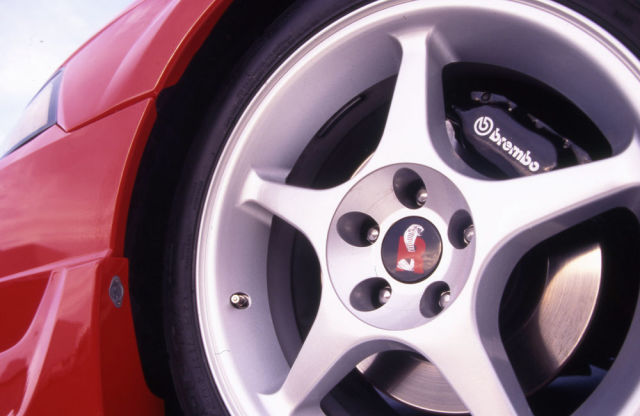
the 4-piston Brembo brakes cooled via carbon- fiber ducting can be
appreciated. I had the opportunity to drive both a stock Cobra R and one
fitted with a rollcage and a differential cooler that was being used in
a 24-hour durability test under competition conditions at the Texas
Motorsports Ranch outside Fort Worth.
Set
up as a country club for car enthusiasts, the Texas Motorsports Ranch
circuit is demanding, with relatively short straights that leave little
time to rest, contemplate the many turns or fully enjoy the Cobra R's
ability to attain high speeds. Yet, the difficult layout demonstrated
the accuracy of the steering, the willingness of the suspension to
respond to those inputs and the effectiveness of the braking package. In
track testing we were able to haul the Cobra R down from 60 in 123 ft.
and from 80 in just 212.
If
the stock Cobra R was good, the track version was flat-out great. The
rollcage on the endurance car stiffened the structure that much more,
which again allowed the steering and chassis to work more efficiently.
Equipped with competition-level brake pads, the race-prepped Cobra R
didn't miss a beat. Even after it was flogged for 24 hours, it was still
quick, surefooted and above all predictable. If the back end stepped
out, it was easy to gather back up and with tremendous reserves of
power, to get back up to speed in short order. The independent rear
suspension, unlike the live axle in the Mustang GT, has a nice, settled
feel to it. The strength of the Cobra R isn't so much the 385 bhp, but
rather the 385 lb.-ft. of torque, which is doled out in a nice fat band
between 2000 and 4000 rpm. On some of the tighter portions of the track
where 2nd gear was the preferred choice, 3rd would suffice, thanks to
the abundant torque.
This
car is big fun, the sort that begs to be driven hard on the throttle.
It pulls mightily out of the corners and over steer is easily summoned
with a quick stab on the accelerator. While the Cobra R is a winner in
the Mustang versus Camaro war, and runs through the quarter mile in a
virtual dead heat with the current Corvette, it's a Pyrrhic victory at
best because a mere 300 cars are being produced at a premium price—
$54,995. Therein lies the real challenge for Ford. The Cobra R is a nice
start—now let's see some real numbers, as in volume, out on the
street.
2000 Ford SVT Mustang Cobra R
Online Money Chat Rooms!
You can make money chatting online when you join a chat service that pays. Video-chat, video sharing, get-paid chat programs and forums are several ways that you can make money at home in your spare time. Video-chat websites allow you to choose either a one-way video chat or a cam-to-cam video chat with other members. Other types of chat services require you to create an account with them and post quality content on their websites.


